
Like the flex nib….

The XV Flex Pro is a soft, tipped flex nib. Write the way you always do, press a little on the capitals, and your lines swell from 0.4 to 2.0 mm. No calligraphy lessons needed.
XV Nusa + Flex Pro nib: 1 072,00 kr1 715,00 kr
🚚 Free tracked shipping · 7–12 business days

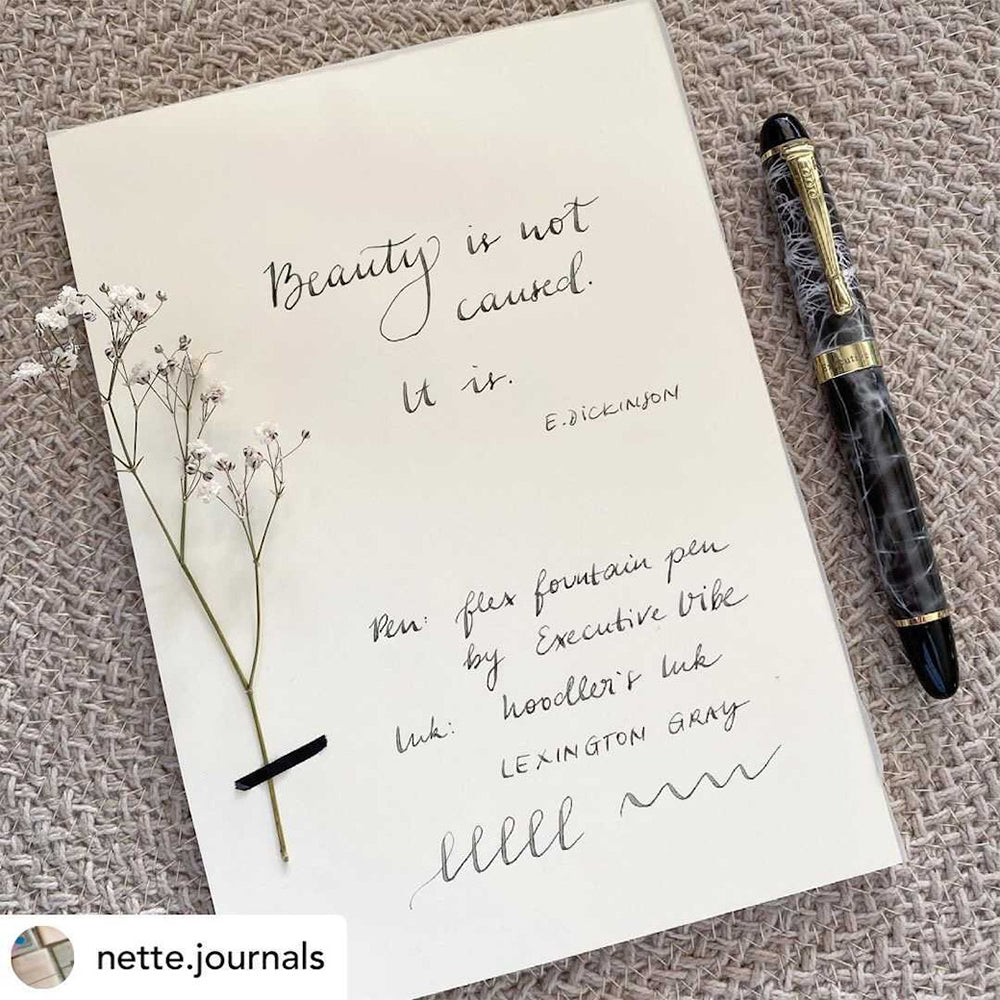
Look closely at the sample. The only thing happening is a little more pressure on the capitals — no special grip, no guide sheet, no particular paper.
That's what tipping buys you. The nib flexes when you lean on it and goes straight back to writing a shopping list when you don't, on whatever is already on your desk.
The row of loops is the only part that takes practice. The rest is just your handwriting, with the volume turned up.
Flex nibs get sold on adjectives — soft, springy, vintage. None of them tell you the one thing you feel after forty minutes of writing: how hard you have to press.

Tines pressed to exactly 1 mm apart. 277.5 g. Buy one and check it.
| Nib | Force to open the tines 1 mm |
|---|---|
| Magna Carta 14K gold | ~190 g |
| XV Flex Pro — steel | 277.5 g |
| Montblanc 18K gold | ~360 g |
| Pilot 14K gold | ~400 g |
Ours was measured in-house and photographed. The comparison figures are published bench measurements using the same method — tines pressed to 1 mm, force read off a scale.
A 14K gold Pilot needs about 44% more force than our steel nib. An 18K Montblanc needs about 30% more.
Gold is the softer metal, but flex isn't decided by the metal — it's geometry. Tine length, how far back the shoulders are cut, how thin the steel is at the flex point. Getting those three right is what the two years and the three manufacturers were actually for.
Both of these are our nibs, in the same pen body. Left: XV Gold Flex, untipped, for people who already know how to handle a dip nib. Right: XV Flex Pro, tipped, for everyone else. One minute to swap.
Both screw into the same pen. They are not two versions of one nib — they're two different instruments, and picking the wrong one is the most common mistake people make with flex.
XV Flex Pro
Tipped · Soft
XV Gold Flex
Untipped · Sharp
It's the one almost everyone should start with. It flexes when you ask it to and behaves itself when you don't, on the paper already on your desk.
The Gold Flex is the better nib in trained hands and the wrong nib in untrained ones. That single choice, made the wrong way round, is behind nearly every disappointed review we've ever had — and we'd rather lose the upsell than have you write another one.


In a fitted presentation box — not a padded envelope. It looks like a gift because it is one.
A complete threaded nib unit, not a loose nib. No tools, no fitting, no guesswork.
Swaps in under a minute, so one pen covers your notes on Monday and your letters on Sunday.
Collection quality: a nib that earns its place among your finest pens.


Making a thin nib bend is easy. Making it bend and keep up with ink is the whole problem — it's the same problem that has Pilot FA owners buying aftermarket feeds for a $320 pen.
The tolerance that matters is where the feed channel meets the flex point. Two of the manufacturers we worked with couldn't hold it consistently. The third could.
We design the nib. They hold the tolerance. That division of labour is why it took two years instead of two months.
Overall rating: 4.9 / 5 from 4908 reviews.
Like the flex nib….

As a music teacher, I need a pen that feels balanced in the hand for marking up sheet music. The XV Nusa sits beautifully on my piano, and the "Executive Vibe" branding is spot on. The XV Flex Pro Nib made a huge difference for anyone in the art space!

I’m a stickler for handwritten Christmas cards, and this smoky XV Nusa is a dream. It looks so sophisticated paired with my holiday journals. The XV Flex Pro Nib is the best in the industry! It makes the act of writing feel like a celebration.

I’m already prepping for the new year, and the XV Nusa is my new daily driver. I’m a "planner addict," and I need a pen that can keep up with my rapid-fire to-do lists. It’s comfortable for long writing sessions, and let’s be honest, it looks great on my desk next to my snacks!

I use this pen specifically for my morning study and reflection time. The blue resin is stunning, and it glides across the page effortlessly. It feels substantial and helps me stay focused while I’m taking notes on important life principles. Solid 5 stars.

I couldn't wait until the 25th to open this! The Transparent Blue looks like a sapphire ornament under the tree lights. The presentation box is high-quality and makes it look far more expensive than it actually is. If you have a writer in the family, stop looking! This is the gift.

I couldn't wait until the 25th to open this! The Transparent Blue looks like a sapphire ornament under the tree lights. The presentation box is high-quality and makes it look far more expensive than it actually is. If you have a writer in the family, stop looking! This is the gift.

I use this pen specifically for my morning study and reflection time. The blue resin is stunning, and it glides across the page effortlessly. It feels substantial and helps me stay focused while I’m taking notes on important life principles. Solid 5 stars.

I’m already prepping for the new year, and the XV Nusa is my new daily driver. I’m a "planner addict," and I need a pen that can keep up with my rapid-fire to-do lists. It’s comfortable for long writing sessions, and let’s be honest, it looks great on my desk next to my snacks!

I bought the XV Nusa Forest to match my guinea pigs' favorite snack, romaine lettuce! I use it daily to log their feeding schedules and weights. It’s incredibly lightweight, and the ink flow is so smooth it doesn't skip even when I’m writing in a hurry before floor time. A fun, vibrant tool for a busy pet parent!

I spend 10 hours a day on my Mac, but I still believe in the power of the handwritten note. XV Nusa Forest adds a perfect pop of color to my otherwise grayscale desk setup. It’s sleek, modern, and the screw-cap feels very secure. It’s the perfect bridge between my tech and my tactile thoughts.

I spend 10 hours a day on my Mac, but I still believe in the power of the handwritten note. XV Nusa Forest adds a perfect pop of color to my otherwise grayscale desk setup. It’s sleek, modern, and the screw-cap feels very secure. It’s the perfect bridge between my tech and my tactile thoughts.

I bought the XV Nusa Forest to match my guinea pigs' favorite snack, romaine lettuce! I use it daily to log their feeding schedules and weights. It’s incredibly lightweight, and the ink flow is so smooth it doesn't skip even when I’m writing in a hurry before floor time. A fun, vibrant tool for a busy pet parent!

As a music teacher, I need a pen that feels balanced in the hand for marking up sheet music. The XV Nusa sits beautifully on my piano, and the "Executive Vibe" branding is spot on. The XV Flex Pro Nib made a huge difference for anyone in the art space!

I’m a stickler for handwritten Christmas cards, and this smoky XV Nusa is a dream. It looks so sophisticated paired with my holiday journals. The XV Flex Pro Nib is the best in the industry! It makes the act of writing feel like a celebration.

I couldn't wait until the 25th to open this! The Transparent Blue looks like a sapphire ornament under the tree lights. The presentation box is high-quality and makes it look far more expensive than it actually is. If you have a writer in the family, stop looking! This is the gift.

I use this pen specifically for my morning study and reflection time. The blue resin is stunning, and it glides across the page effortlessly. It feels substantial and helps me stay focused while I’m taking notes on important life principles. Solid 5 stars.

I’m already prepping for the new year, and the XV Nusa is my new daily driver. I’m a "planner addict," and I need a pen that can keep up with my rapid-fire to-do lists. It’s comfortable for long writing sessions, and let’s be honest, it looks great on my desk next to my snacks!

I’m a stickler for handwritten Christmas cards, and this smoky XV Nusa is a dream. It looks so sophisticated paired with my holiday journals. The XV Flex Pro Nib is the best in the industry! It makes the act of writing feel like a celebration.

As a music teacher, I need a pen that feels balanced in the hand for marking up sheet music. The XV Nusa sits beautifully on my piano, and the "Executive Vibe" branding is spot on. The XV Flex Pro Nib made a huge difference for anyone in the art space!

I bought the XV Nusa Forest to match my guinea pigs' favorite snack, romaine lettuce! I use it daily to log their feeding schedules and weights. It’s incredibly lightweight, and the ink flow is so smooth it doesn't skip even when I’m writing in a hurry before floor time. A fun, vibrant tool for a busy pet parent!

I spend 10 hours a day on my Mac, but I still believe in the power of the handwritten note. XV Nusa Forest adds a perfect pop of color to my otherwise grayscale desk setup. It’s sleek, modern, and the screw-cap feels very secure. It’s the perfect bridge between my tech and my tactile thoughts.

I’m already prepping for the new year, and the XV Nusa is my new daily driver. I’m a "planner addict," and I need a pen that can keep up with my rapid-fire to-do lists. It’s comfortable for long writing sessions, and let’s be honest, it looks great on my desk next to my snacks!

I’m a stickler for handwritten Christmas cards, and this smoky XV Nusa is a dream. It looks so sophisticated paired with my holiday journals. The XV Flex Pro Nib is the best in the industry! It makes the act of writing feel like a celebration.

I use this pen specifically for my morning study and reflection time. The blue resin is stunning, and it glides across the page effortlessly. It feels substantial and helps me stay focused while I’m taking notes on important life principles. Solid 5 stars.

I couldn't wait until the 25th to open this! The Transparent Blue looks like a sapphire ornament under the tree lights. The presentation box is high-quality and makes it look far more expensive than it actually is. If you have a writer in the family, stop looking! This is the gift.

I spend 10 hours a day on my Mac, but I still believe in the power of the handwritten note. XV Nusa Forest adds a perfect pop of color to my otherwise grayscale desk setup. It’s sleek, modern, and the screw-cap feels very secure. It’s the perfect bridge between my tech and my tactile thoughts.

As a music teacher, I need a pen that feels balanced in the hand for marking up sheet music. The XV Nusa sits beautifully on my piano, and the "Executive Vibe" branding is spot on. The XV Flex Pro Nib made a huge difference for anyone in the art space!

I bought the XV Nusa Forest to match my guinea pigs' favorite snack, romaine lettuce! I use it daily to log their feeding schedules and weights. It’s incredibly lightweight, and the ink flow is so smooth it doesn't skip even when I’m writing in a hurry before floor time. A fun, vibrant tool for a busy pet parent!

Holds ink well, writes consistently, and looks elegant on my desk. Perfect combination.

I’ve been using it daily for work and classes—never once had an ink burp or skip.

The transparency sold me, but the comfort and flow made me a fan. Excellent pen overall.

I’ve been using it daily for work and classes—never once had an ink burp or skip.

Writes smoother than some of my gold-nib pens. Truly impressive.

Easy to clean and even easier to refill. The engineering shows in the simplicity.

Light, balanced, and always ready to write. I use it for both sketches and notes.

The cap threads feel refined, not scratchy. Small detail, big difference.

Watching shimmering inks settle inside the barrel is beautiful. Perfect for ink lovers.

The transparency sold me, but the comfort and flow made me a fan. Excellent pen overall.

Holds ink well, writes consistently, and looks elegant on my desk. Perfect combination.